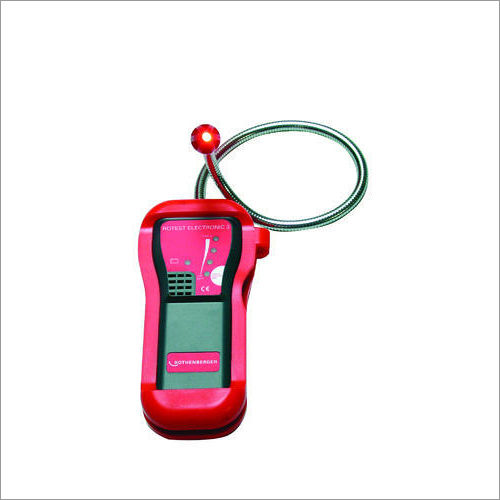
About Leakage Testing Tools and Equipment
Specification
|
Type Of Testing Machines
|
Inspection & Locating Leakages
|
|
Model Name/Number
|
Depends On Model Selected
|
|
Weight
|
Depends On Model Selected
|
|
Capacity
|
Depends On Model Selected
|
|
Brand
|
Rothenberger(Germany)
|
|
Power Source
|
Manual & Electric
|
Comprehensive Detection TechnologyUtilizing both pressure drop and sensitive sensor monitoring, our leakage testing equipment ensures reliable pinpoint detection in pipelines, tanks, valves, and HVAC systems. The system rapidly identifies leaks with an accuracy of 1% FS, delivering results in under two seconds, and is suitable for air, nitrogen, water, and other non-corrosive gases.
Intuitive Digital LCD InterfaceThe equipment features an easy-to-read digital LCD display with backlight, providing crystal-clear visualization even in poorly lit environments. The display guides users through each step of the testing process and incorporates audio-visual alarm notifications for immediate awareness when leaks are detected.
Rugged, Safe, and User-Focused DesignCrafted from high-grade reinforced plastic and metal, this leak tester is resistant to water, chemicals, and corrosion. Quick-connect port fittings simplify setup, while a robust insulation box ensures user safety from electrical shocks. Integrated overpressure and short-circuit protections enhance operational security.
FAQ's of Leakage Testing Tools and Equipment:
Q: How does the digital leakage testing tool detect leaks in pipelines and other equipment?
A: The device employs a dual detection method: pressure drop analysis and advanced sensor monitoring. When connected via quick-connect ports to the system under test (using air, nitrogen, water, or non-corrosive gases), it measures pressure changes and uses its sensors to swiftly detect even minor leaks. Audio-visual alarms immediately alert the operator to any issues found.
Q: What applications and industries can benefit from using this leakage testing equipment?
A: This tool is versatile and ideal for use in testing pipelines, tanks, HVAC systems, valves, and various industrial apparatus. It is widely adopted in industries like oil & gas, water treatment, power generation, manufacturing, and HVAC maintenance, wherever reliable leak detection is critical for safety and efficiency.
Q: When should I use the built-in memory feature for test logs?
A: The built-in memory can store up to 200 test logs, making it beneficial for ongoing projects, compliance verification, or when documentation of test history is required for quality assurance. Simply initiate a test, and the device automatically records key results, which can later be reviewed or exported as needed.
Q: Where can this leakage tester be safely operated in terms of environment?
A: Designed with robust, corrosion-resistant and water-resistant housing, the equipment can be used both indoors and outdoors, within a temperature range of -10C to +50C. Its weight (about 8.5 kg) and included carrying case make it portable for on-site industrial applications and remote testing situations.
Q: What process is involved in setting up and measuring with this leakage testing tool?
A: Setup is straightforward: connect the hoses via quick-connect fittings to the target system, select the appropriate test medium (air, nitrogen, etc.), power up (AC or battery), and follow the onscreen instructions on the LCD. Results are displayed in under two seconds, with accurate leak status and alarms.
Q: How does the integrated protection system enhance user safety?
A: The device includes overpressure and short-circuit protection systems to prevent damage to both the tester and tested equipment. In addition, the insulation box isolates electrical components, safeguarding operators from accidental shocks during testing in high-voltage environments (measuring voltage up to 1000V).
Q: What benefits does battery operation provide?
A: The flexibility to run on rechargeable lithium-ion or standard AA batteries, alongside AC power, offers true portability. This enables uninterrupted field testing, especially in remote areas or on large industrial sites where power access may be limited.






 English
 Spanish
 French
 German
 Italian
 Chinese (Simplified)
 Japanese
 Korean
 Arabic
 Portuguese
 Send Inquiry
 Send Inquiry

